

Trisha Lopez


April 2026 Honoree
Trisha Lopez
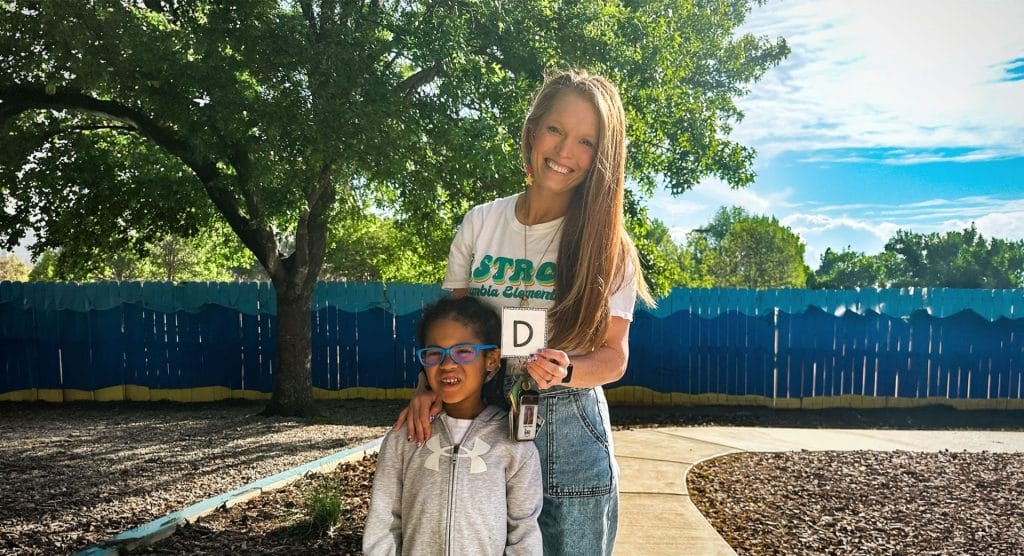
with her student, DJ Lamar
Columbia Elementary School
, Madison
, Alabama
Available On:


LISTEN TO THE EPISODE
"We need kids who have additional needs because it gives us a heart for everyone and everything, and it helps us understand people a whole lot better."
Trisha Lopez
"I can tell by the way he's confidently taking his time to get these words out, that they're doing the same thing at school. They're giving him that platform to take his time."
Rebecca Lamar
"I'm not a perfect teacher. I need to learn. And [asking for] help isn't that you're not doing it right. Help is 'How can I be better?'"
Trisha Lopez
"The ease of [his] whole routine in the evenings has been much more impactful on his learning, his demeanor, his confidence."
Rebecca Lamar
"I explain to a lot of people they might be different, or they might engage in behaviors, but that's them communicating. You have to work with them and give them grace and give them time and space to learn how to communicate more effectively, rather than through behaviors."
Trisha Lopez
"These two years that he's been with Mrs. Lopez, I have been able to focus on me because now DJ is learning his world."
Rebecca Lamar
"Deep down, I want them to go away loving school and loving being here and feeling loved and feeling safe."
Trisha Lopez
"I know that Mrs. Lopez is very impactful on my son, and she will always be a part of his life."
Rebecca Lamar
Description
To celebrate Autism Acceptance Month, we are honored to share the story of an incredible educator who has made an impact on the life of a student with autism. Trisha Lopez, an elementary school Special Education teacher at Columbia Elementary School in Madison, Alabama, is the recipient of our April 2026 Honored National Teaching Award. She was nominated for this award by the parent of her student, DJ. Joining Trisha in this episode is DJ’s mom, Rebecca.
You’ll hear about:
- Trisha Lopez’s journey to becoming a teacher.
- The impact Trisha has had on DJ and his mom.
- Trisha’s dedication to creating an encouraging environment where students’ needs are exceeded.
- Trisha’s passion for supporting families with children with disabilities.
You’ll also hear from Britton Banowsky, the Executive Director of the College Football Playoff Foundation. He shares about a teacher who left an incredible impact on their journey in our segment “Teachers Who Inspired”. He leads the organization’s philanthropic initiative, as well as its capstone project, Extra Yard for Teachers (EYFT). Banowsky’s role includes coordinating all legacy investments in host cities, expanding positive impact for teachers year-round, as well as directing the long-term strategic plan for the CFP Foundation.
Links Mentioned
- Nominate a teacher for our Honored National Teaching Award: https://www.honored.org/nominate/
- Read the incredible nomination for Trisha Lopez: https://www.honored.org/nominees/trisha-lopez/
- Learn more about the College Football Playoff Foundation: https://cfp-foundation.org/
- Follow us on Instagram: https://www.instagram.com/honored/
- Follow us on Twitter: https://x.com/honored/
- Follow us on Facebook: https://www.facebook.com/Honored.org/
- Follow us on LinkedIn: https://www.linkedin.com/company/honored.org
- Follow us on TikTok: https://www.tiktok.com/@honoredteachers
Credits
-
- Music by DanaMusic: https://pixabay.com/users/danamusic-31920663/
- Music by AudioCoffee: https://www.audiocoffee.net/
Transcript
TRISHA LOPEZ: What about people with special needs? What do they add to our world? The ability for us to have sympathy, and to have understanding, and to have compassion for people’s differences.
HANNAH BOWYER-RIVETTE: Hello everybody, and welcome back to Inspiring Teachers: The Honored Podcast, where we shine a spotlight on life-changing teachers across the country. I’m Hannah, your podcast host, and our podcast is brought to you by Honored, which is a national nonprofit organization dedicated to honoring and elevating great teachers nationwide. Every month of the school year at Honored, we select an exceptional educator in the United States to be the recipient of the $5,000 Honored National Teaching Award. To learn more about our organization, you can go to our website at honored.org.
We are so excited to have you listening in on another Honoree podcast episode. To celebrate Autism Acceptance Month, we are honored to share the story of an incredible educator who has made an impact on the life of a student with autism. Today, we are joined by Trisha Lopez, an elementary school Special Education teacher at Columbia Elementary School in Madison, Alabama. She was nominated for this award by Rebecca, the parent of her student, DJ. To help share the impact of Trisha’s teaching, we are joined today by Rebecca.
Before we dive into Trisha’s story, we are excited to kick off our Honoree episode with our special segment, ‘Teachers Who Inspired’, where we invite individuals to share a story about a teacher who had a lasting impact on their lives. Today, we’re thrilled to have our guest on our special segment, Britton Banowsky, the Executive Director of the College Football Playoff Foundation.
He leads the organization’s philanthropic initiative, as well as its capstone project, Extra Yard for Teachers (EYFT). Banowsky’s role includes coordinating all legacy investments in host cities, expanding positive impact for teachers year-round, as well as directing the long-term strategic plan for the College Football Playoff Foundation.
BRITTON BANOWSKY: You know, so many teachers impacted me throughout not only my childhood, but also through college. So I have numerous, numerous stories. The one that comes to mind, though, is my teacher named Joe Gomez, Professor Gomez, or Coach Gomez. So he was my algebra teacher and geometry teacher in high school, but he was also my head football coach. And so not only did he do a great job of teaching me math, but he also taught me character building and taught me how to be a good person on the football field and off the football field. So I’d say Joe Gomez was the guy I think of first, who shaped my life.
HANNAH BOWYER-RIVETTE: Throughout the rest of the episode, we’ll share Trisha Lopez’s story and the incredible impact she has on her students. To start us off, you’ll hear from Trisha, who reflects on what led her to teaching as she followed her childhood passions and inspirations from many teachers along the way.
TRISHA LOPEZ: Honestly, I think that I was born to teach. I wanted to teach ever since I was a kindergartener. My kindergarten teacher, I would say she inspired me because she was so encouraging of me to help others. And then in high school, I had another teacher, Ms. Roll, who was amazing, and she encouraged me so much. I honestly barely even remember her class. I remember her as a person. So teachers make such a massive impact on your life. And those are some of those reasons.
When I was 17 years old, 16 years old, going to college, I knew I was going in for education. There wasn’t a question. I had no other options. And I don’t think I ever really did my entire life. I didn’t want to be a firefighter or a police officer. I wanted to be a teacher my whole life. So there were a few teachers along the way who helped me make that decision. And in college, I had really planned on teaching elementary general education.
And then I had a professor who challenged me, and she really put my mind in a spot that was like, “Oh, I really, really love special education. Wow. These kids make such a massively beautiful impact on our world, and we need them.” We need kids with significant disabilities. We need kids who have additional needs, because it gives us a heart for everyone and everything, and it helps us understand people a whole lot better. And one of her examples was like, “If you had to go to another planet and restart and bring certain people, what would you bring?”
And all of us had the typical: a lawyer, a doctor, you want women, you want men, you want a variety of people. Well, she added, “What about people with special needs? What do they add to our world?” The ability for us to have sympathy, and to have understanding, and to have compassion for people’s differences. So her bringing that up was like, “Oh, wow, that’s what I want to do. I love that.”
And then I went, and I taught third grade my first year, and I loved it, but by the end of the year, I was like, I’m going to do self-contained special education. That’s what I want to do. That’s what most of my student teaching was, that’s what I want to do. And I told my third-grade class, I’m not coming back next year. But I told them, “You have to follow your dreams. You have to follow what you want to do.” And now, 10, 11 years later, I’m here in pretty much a very similar position. I’ve had various kids along the way, but I love it, and the kids are why I’m here, because I love them.
HANNAH BOWYER-RIVETTE: To learn more about Trisha’s impact, we talked with Rebecca, whose son, DJ, is nonverbal with autism and ADHD. She has witnessed incredible growth in DJ, from him speaking for the first time to finding confidence in stepping outside his comfort zone. She credits Trisha for creating a space where her son feels safe and empowered to find his voice on his own terms.
REBECCA LAMAR: I‘ve been showing this person some love since I met her. This is the one thing that stood out. My son is nonverbal autism and a little bit of ADHD. At the point of coming to Mrs. Lopez’s class, he wasn’t speaking. I never heard him tell me, “I love you.” So three months into the semester, he said it. That let me know that she was taking the time to make him feel confident.
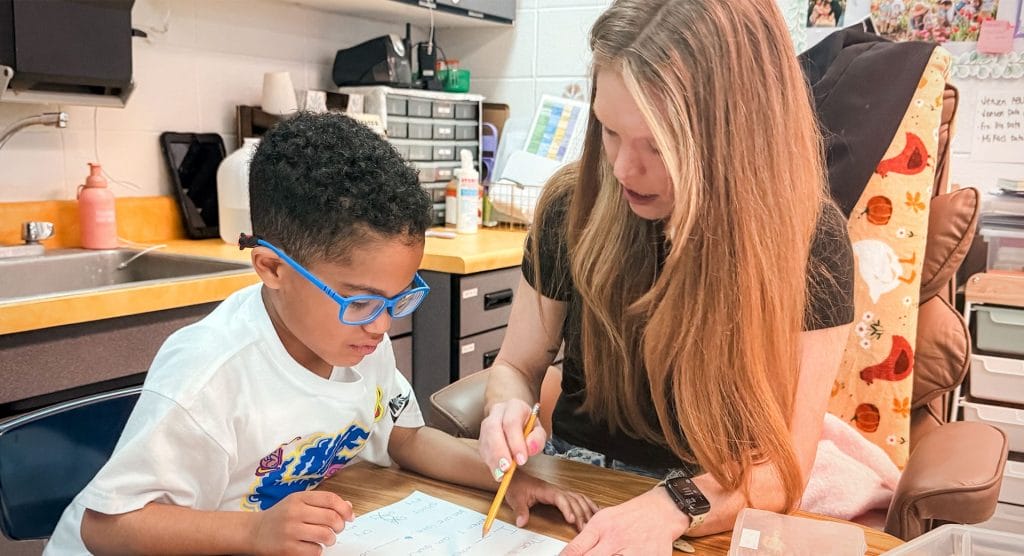
And that wasn’t it. That wasn’t it. I started seeing a whole lot more come from him, where he was really trying to say sentences. It was hard for him because he’s been quiet. He hasn’t been using those muscles, and so it was a lot of “What, what did you say?” And I’m waiting, and I can tell by the way he’s confidently taking his time to get these words out, that they’re doing the same thing at school. They’re giving him that platform to take his time. Don’t feel rushed.
Because you can tell some kids, there’s a difference. When they feel rushed, they get under pressure, and then the next thing you know, they don’t say what they need to say. That moment right there, I put it this way. I made it my business to show her my appreciation from that moment on. I love me some teachers, period, but this person right here, I had to do it a different way. I’ve been her room mom last year, and this year, I volunteer in every way that I possibly can.
I communicate with her. I’m a very private person, but for this woman right here, I share details with her because it matters. She needs to know what life is looking like for DJ at home. She needs to know when I’m falling off. And I’m glad I’m doing that. I’m glad I did that. So with all this love I’ve been pouring into her, when I saw this opportunity, you think I wasn’t? That’s what made me do it. I’m not going to stop. I’m not going to stop showing my appreciation.
And the thing that helps, too, is that I don’t just see it with my kid. I see her doing it with the rest of the kids. You’ve got to see this woman work. And I’m not over exaggerating. I don’t do that. I’m telling it just like it is. So I jumped on the opportunity to do this because she deserves it. This kind of work, when there are teachers out there that do what she does to the extent that she does, we as parents, as a community, should always recognize them.
HANNAH BOWYER-RIVETTE: In a classroom where students have varying abilities, Trisha is passionate about ensuring all students can work toward their unique goals. Her work is rooted in collaboration, adaptability, and a willingness to ask others for help. Through structured stations and shared support from paraprofessionals, every student receives the individualized attention they deserve.
TRISHA LOPEZ: It varies year to year, and it’s accepting resources and accepting help. I think the main thing I have learned is to let go of the things you cannot control, and take what you have and provide from that. This year, there are a lot of people out sick constantly. We’re losing teachers left and right. We’re losing paraprofessionals left and right. So unfortunately, that does impact our students, and so I can’t just sit there and be frustrated and angry at that. I have to do something for the kids. So it’s really finding the resources that you have at that point and accepting the help.
And I’m not a perfect teacher. I need to learn. I have so much to learn in so many areas. But what can I take from this person? What can I take from this person? And help isn’t that you’re not doing it right. Help is “How can I be better?” One of the main things that I do at this point is I have a very detailed, specific schedule throughout my day. And again, it changes from year to year, and I had to change my schedule probably 16 times the first semester because I had an adult in, now I don’t have an extra adult, now this person’s out, now I have a new kid, now I have another new kid.
So I’ve had to change what I’m doing and how my stations are running, all based on that. And so now I have IEP boxes for every single student. They have file folders or task boxes for their goals. And so in the morning, I’m assigned certain kids, one of my paras is assigned certain kids, and another one of my paras is assigned certain kids. And so we rotate between those kids and work on their IEP goals. And in the afternoon, I have a reading, writing, and a math task box, and I’m adapting to what that student needs, if he needs additional supports or accommodations to provide those.
And in those stations, we’re rotating between, and we rotate what content they’re learning every single week, and then we rotate kids every single week. The kids rotate throughout the day, but who we start with, we rotate as well, so I make sure that if we do miss rotations, that we’re still getting access to all of the kids. And routine is really important for the kids, so the schedule is the same, but also learning how to change that schedule and adapt to that is really important as well.
So that rotating the kids is a small thing to teach them, “Okay, but you’re not starting at Mrs. Lopez’s table every single day. You might start at Ms. Jen’s table next week.” And that helps them with that change because I have had kids in the past who, even that is a big change for them, and they don’t do well with that, but they learn, and they adapt, and they figure it out.
HANNAH BOWYER-RIVETTE: Rebecca initially hesitated placing her son in a public school setting as she was unsure that his routine and needs would be met. Two years into having Trisha as his teacher, this uncertainty has slowly evolved into a deep trust. This stability of being in the same classroom has had profound effects on DJ not only academically, but in bringing a sense of ease to home as well.
REBECCA LAMAR: That was one of the reasons why I hesitated with school, even though I know there is a routine. With autism, just as a kid having any disability, would that routine stay in the school setting? If you were to meet DJ, you can tell immediately that he is an intelligent kid, and I didn’t want any setbacks because the system tends to want to meet quotas. And that tends to be a negative impact on kids, especially kids with disabilities.
So putting him in school and then getting the luck of getting Mrs. Lopez again, not only did it allow him to continue his growth, but that routine of seeing the same person, getting the same guidance from the same person, being in the same class, I can tell it did a lot for him to feel comfortable with school and at home. It’s where he’s doing chores. Every day he comes home from school, he knows to put his backpack up. I mean, put it up, empty it out, take everything out, give me his folder.
Before he can get his iPad, he has to trace his name, his full name, and I won’t give him that iPad until 3:30. I make him look at the clock, “iPad?”, and I’ll say, “What does the clock say?” And the clock that I have is not a digital clock. It’s old school, what we can call old school. And he’ll know what 3:30 is, he’ll know that he cannot touch that iPad, don’t come ask me till 3:30. So now he knows, come to me at 3:30 with his iPad. I give it to him, and he gets on it for 30 minutes because after that, we’re going to work on our spelling or whatever is assigned for the week.
The ease of that whole routine in the evenings has been much more impactful on his learning, his demeanor, his confidence, more this year than last year. Last year, there was a massive improvement. This year, most definitely. So I know that his being in Mrs. Lopez’s class this year has definitely been positive for him.
HANNAH BOWYER-RIVETTE: Acceptance and belonging is central to Trisha’s teaching as she cultivates a classroom where every student is valued and celebrated for who they are. She communicates closely with students and their families to understand each child’s strengths, goals, and accommodations. She is intentional about speaking highly about her students and recognizing that their communication and expression styles deserve patience and respect.
TRISHA LOPEZ: To be honest, I’m a pretty blunt and open person. I’m gonna come in and be like, this is this kid’s strengths, this is what they can do, this is what accommodations they need to have. They belong here, so they’re coming. But also, I’m going to have a conversation. I’m like, “I need you to tell me what are your needs in the classroom? How can I help you meet those needs?” How can I help this kid accommodate him in the classroom and make him more successful in the classroom, and us not be a disruption?
So I expect everyone to love my kids. I love them. I expect people to love them. You’re in teaching, you love kids. That is the expectation. So I always speak highly of my kids, and I explain to a lot of people they might be different, or they might engage in behaviors, but that’s them communicating. You have to work with them and give them grace and give them time and space to learn how to communicate more effectively, rather than through behaviors.
So these kids need a little more patience. And I’ve learned that speaking to people and explaining to people that alone, they have this innate nature to be kind and to be happy, they don’t know how to do that. And if you are frustrated and you don’t know how to tell someone that, or you don’t even know how to understand it yourself, how are you going to behave? You have to try to understand that.
So I always try to explain to people, try to understand where they’re coming from, why they’re doing what they’re doing. They’re not trying to be harsh; they’re not trying to be mean. They are good people, and they are good kids, and they have such big hearts. So give them the opportunity to show that and to express that, because if you don’t, then you’re not going to get to know this world and the beauty that it holds.
HANNAH BOWYER-RIVETTE: From the time she received DJ’s diagnosis when he was two, Rebecca’s time has been spent researching autism, collaborating with providers, and focusing on his development. But over the past two years, as he has spent time in Trisha’s classroom, DJ’s growth has allowed Rebecca to slowly carve out time for herself. In turn, DJ has started to mirror her actions of caring for himself and gaining more independence.
REBECCA LAMAR: With being a single mom and getting DJ’s diagnosis around, I believe it was two. My whole time was researching, reading a bunch of literature, videos, whatever I can get my hands on, even asking 1,000 questions to each provider. My years have been nothing but DJ, autism, and ADHD. These two years that he’s been with Lopez, I have been able to focus on me because now DJ is learning his world. He’s able to manage his sensory input. He’s able to verbalize whatever he’s feeling, whatever he wants to do. Those milestones that DJ has crossed.
And there are some friends of mine that have six year olds or seven year olds, and their kids are not diagnosed with anything, but as a parent, yes, I do compare, but not compare to who’s better or who’s less than but as a template for me to ensure that my son is remaining an equal in that group of seven year olds. And I’m proud to say he’s there. There are a couple of things that we still need to work on. He still has tantrums, but those tantrums are so brief in comparison to how they were before Lopez.
But yeah, now my world as a parent, I’m able to focus more on my personal endeavors and have my son watch. He sees me studying. He sees me typing. Now, I see him wanting to type. The patience he seen me behind a book. Now I can read a book. I’m a book reader. And I truly believe that him seeing me do that, because it’s been about me reading books to him all this whole time.
But now that he sees mommy reading a book, I see him picking up books on his own. Not waiting for bedtime or when I pick it up and read it to him, he’s picking it up. He’s sitting there. He’s flipping the pages. Those are milestones, and it’s carrying over from his maturity in his world and his experience with being in school, being under Mrs. Lopez’s guidance.
HANNAH BOWYER-RIVETTE: In Trisha’s classroom, collaboration with her paraprofessionals is key. She shares how building trust with her team not only creates a supportive work environment, but it also ensures students find at least one trusted adult they can connect with. This team-centered environment builds a culture of respect and a shared goal to ensure that students and educators can thrive.
TRISHA LOPEZ: What’s great about having multiple people is, honestly, some kids just don’t bond with you. And it’s the reality of it, not all adults bond with each other. We’re not all going to be friends; our personalities don’t all match. And it’s so similar to a child to a teacher. Obviously, I’m going to love every single one of my kids, but that doesn’t mean they’re like, “Oh, I love her.” Some of these kids are going to run to me, and they love me. And some kids are going to be like, “I’m going to go to her.”
And I have two adults in my room, actually three, and they are the sweetest humans. But each one of these kids finds someone to bond with. If they don’t have that head teacher, then they might have a para or a speech teacher. So then that can provide them a comfort zone, like, if I’m upset, I’m frustrated, and I might not be able to communicate it to you because I don’t have that connection, which is okay, I can find someone else.
And so we can reach out and be like, “Hey, kids having a hard time, I need you to come sit with him. Or can he work to spend time with you?” So like, “Okay, we’re going to work to spend time with the speech teacher.” And that’s what we do. So we’ve used the environment to our advantage. And to be honest, I’m in a phenomenal school. I have the greatest speech therapist, the greatest OTs, PTs, and admin, who love, love, love our kids, and it shows so much.
And our janitor, I love our janitor. He worked with me last year. He was one of my paras, too, but he comes in, and one of my kids who has a hard time bonding with all their paras loves him. So he works for him sometimes. So that’s how great our school environment is. Is having that. And I do want to note, at the beginning of the year, I have a conversation with my paras, and we talk about, “What are our boundaries? What can I not do? What can I not say or do around you that’s going to frustrate you or bother you or hurt your feelings or whatever?”
Just to get our personalities in touch and work off our strengths, work off our weaknesses, and focus on having the conversation that students come first. However, in your personal life, if you have something going on with family, I always tell them, you go home, you deal with that because if your mind is there, it’s not here. So you and your family are first, but when we’re here, the kids are first. So we have that big conversation, and I’ve been very fortunate to have paraprofessionals with me who have such a beautiful heart.
HANNAH BOWYER-RIVETTE: After his time in Trisha’s classroom, Rebecca hopes her son carries a sense of love and belief in himself. At home, DJ often stops to touch a photo of him and Trisha on the refrigerator in acknowledgement of the connection they’ve built. For Rebecca, these small moments remind her that Trisha’s impact extends far beyond the classroom.
REBECCA LAMAR: I know her love will stay with him, the memories. His teacher, after her, whatever struggles he may have adjusting to her, because I know kids with autism have a super duper time adjusting to new things. I hope that in the back of his head, he’s thinking about what would Lopez want him to do in those situations. I know when I speak of her at home, I see him back straight, “Oh yes, yeah, we better keep her happy.” Not out of fear, but out of this is my teacher. I don’t want to let her down.
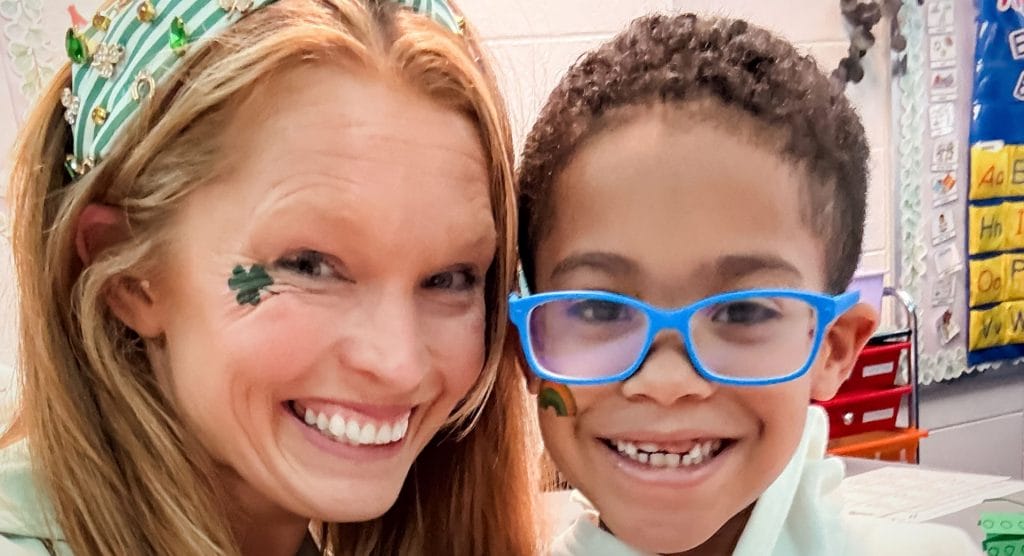
On their first field trip that they had last school year, it was to a farm, they took a beautiful picture together, and I had that picture on my refrigerator. I know that Mrs. Lopez is very impactful on my son, and she will always be a part of his life. I know that no matter what, she’s like a sister to me because we’re so on the same page with this school community vibe.
So the picture is on my refrigerator. There have been times that I’ll see DJ walk by it and he’ll glide his hand over it, as if it were a gesture of, “I love this.” There are toys, there are other pictures on that refrigerator, but that’s the only picture he touches. So I know he thinks very highly of Mrs. Lopez; I do too. I do too. I do not plan on, like most people do, not out of some kind of ill will, but when the school year is over, next, next teacher, next teacher. “Hey, hey, hey, how are you doing?” I know Mrs. Lopez will remain in my son’s life, too.
HANNAH BOWYER-RIVETTE: In response to Rebecca’s story, Trisha affirms that her ultimate goal is for her kids to know they are loved. Every day, she creates a space where her students feel safe and supported because she knows this lays a strong foundation for growth. She hopes these feelings of security carry with them outside of the classroom as they become more comfortable and confident in themselves.
TRISHA LOPEZ: That’s what I want my kids to go home with is that they’re loved. That’s all I care about. Yes, I want them to progress, and I care so much about making sure they get what they need and what they deserve. And if that means me going out of my way and teaching these skills because this is what they need and they can’t get it somewhere else, then I’m going to do that. Deep down, I want them to go away loving school and loving being here and feeling loved and feeling safe.
Today, one of my students ran up to me and, oh, it makes my heart so happy. And I have another kid who, literally, last year, would throw up before coming to school, and this year he’s coming to school, and he’s smiling. He had to wear a helmet before, and now he uses just his headphones. And to me, that shows that he’s happy to be here, and he actually enjoys being here. And seeing them smile, and their happiness, and them feeling loved is the most important thing. It’s a second home, so that’s what we need to provide for them. Yeah, we teach them, but we also love them.
HANNAH BOWYER-RIVETTE: Thank you so much for listening and joining us today to learn more about Trisha Lopez, our April Honoree and recipient of the Honored National Teaching Award. To read more about her story, you can visit our website at honored.org or click the link in the episode description. If you have a teacher who you want to recognize and nominate for our teaching award, you can head to honored.org/nominate to recognize a teacher today. If you enjoyed today’s episode, you can follow us and leave us a review on whatever podcast platform you’re listening in from. Thanks again for listening, and make sure to tune in next month to hear the incredible story of our May Honoree.
Photography By:
Harper Hayes
More Honoree Stories


February
Julian Coleman
Global Leadership Academy West
Philadelphia, Pennsylvania

